
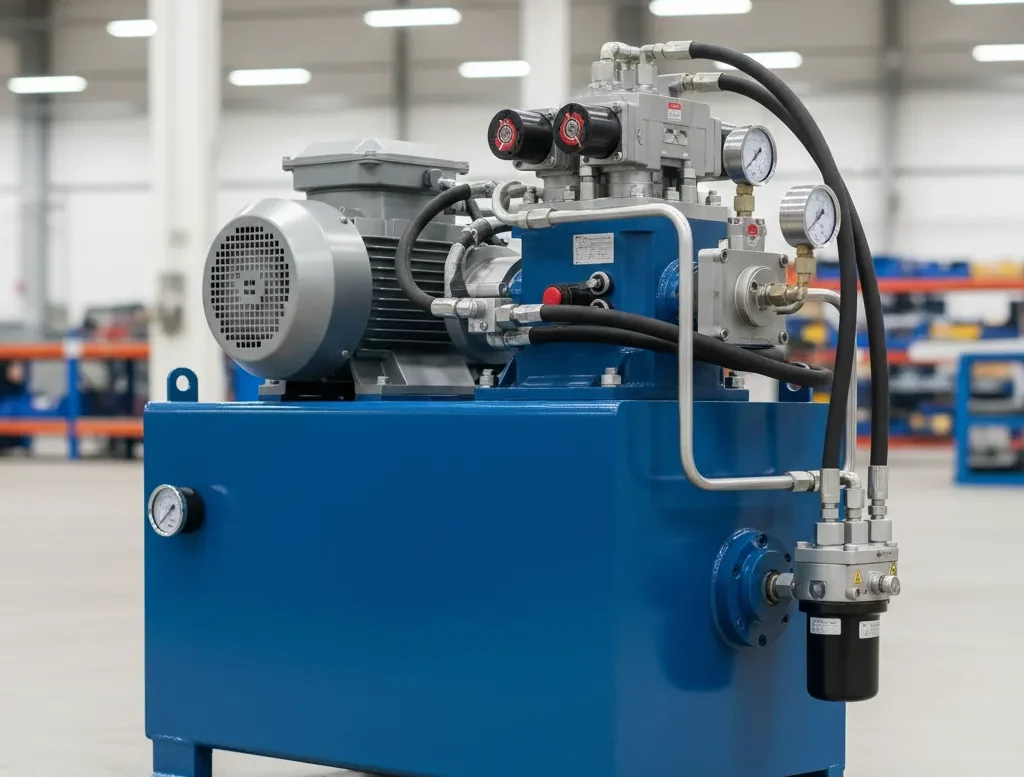
Mobile Hydraulic Specialties provides expert hydraulic power pack design in Melbourne with efficient cooling, reservoir sizing and noise control.
Precision in hydraulic engineering depends on how efficiently every component is designed to handle pressure, temperature, and flow dynamics. At Mobile Hydraulics Specialties, we engineer hydraulic power pack design solutions that deliver superior reliability, energy efficiency, and low maintenance through careful consideration of reservoir sizing, cooling, and noise control.
Reservoir sizing is a fundamental parameter in hydraulic power pack design. The reservoir provides fluid storage, heat dissipation, and air separation, functions that directly affect system stability and component longevity. Incorrect capacity can cause aeration, cavitation, and overheating. Engineers typically size reservoirs at three to five times the pump’s flow rate per minute, but this can vary depending on operating conditions.
Key design factors include:
• Duty cycle: Defines whether the system operates continuously or intermittently, directly influencing reservoir volume, cooling demand, and pump sizing.
• Fluid characteristics: Refers to viscosity, density, and the type of hydraulic fluid used, particularly its stability under varying temperature and pressure conditions.
• Return flow dynamics: Involves monitoring flow velocity and turbulence to minimise aeration, cavitation, and foam formation within the reservoir.
• Thermal loading: Determines how heat is generated and dissipated throughout the system, influencing reservoir capacity and cooling system selection.
• Contaminant control: Ensures proper filtration and fluid settling to maintain oil cleanliness, preventing component wear and extending system life.
Incorporating baffles and diffusers reduces turbulence and allows contaminants to settle, maintaining fluid integrity and consistent performance.
Heat buildup within a hydraulic circuit can quickly reduce system efficiency and degrade seals. Proper thermal control ensures consistent fluid viscosity, stable pressure, and longer component life.
Air-cooled and oil-cooled exchangers are widely used depending on the application type. Air-cooled systems are preferred in mobile or outdoor environments, while oil-cooled configurations are suited for high-duty industrial machinery. Engineers evaluate heat rejection capacity, ambient temperature, and operating duration to specify cooling components accurately.
For deeper technical insights into hydraulic cooling methodologies, refer to the Journal of Fluid Power and Motion Control by the University of Bath.
Hydraulic equipment often generates mechanical and fluid-borne noise from pump pulsations and flow turbulence. Excessive vibration or pressure ripple can reduce operator safety and shorten component life.
Effective noise reduction is achieved by:
• Using acoustic enclosures and isolation mounts to limit structural vibration.
• Selecting vane or helical gear pumps for smoother and quieter operation.
• Applying flexible hose routing and secure clamps to minimise resonance.
• Adding elastomeric couplings to absorb vibration and reduce transmission.
• Positioning return lines below the fluid level to prevent aeration and flow noise.
Integrating elastomeric couplings and tuned damping materials helps achieve compliance with workplace noise standards while maintaining system efficiency.
At Mobile Hydraulics Specialties, every hydraulic system is engineered with precision, reliability, and performance consistency in mind. Our design approach ensures that every component, from the reservoir and cooling system to vibration control, is optimised to achieve maximum operational efficiency and extended equipment life.
Our hydraulic power pack design, components, and system assemblies are built to deliver dependable performance under demanding industrial and mobile conditions. Whether you require a standard configuration or a fully customised design, our experts provide tailored hydraulic power pack solutions that meet specific flow, pressure, and environmental requirements.
Contact us today to discuss your project requirements.
Related Blog Article: Oil Cooler Supply: A Complete Guide for Hydraulic Applications [2025]
Factory 89, 38-40 Popes Road
Keysborough, Victoria, 3173
Phone: (03) 9798-6511
Optimized by NetwizardSEO.com.au


